
In the modern world, the benefits of physical exercise, and being physically healthy, are almost universally understood. Exercise is seen not just as an activity to improve your physical health, but also your health in the mental, emotional and cognitive domains. Regulating stress, improving memory and attention, and promoting healthy aging of the brain are three well known benefits of physical exercise.
Less well known is the science behind how regularly engaging in creativity can have similar benefits across these same domains. In this article I will share contemporary ideas about how creativity promotes health, talk about some of the common reasons why people avoid creativity, and encourage some practices that are accessible to anybody who does not have a creative hobby.
You have likely heard the phrase “put your mask on before helping others”. The intent behind this phrase is to state that if you are not well yourself, it is difficult to show up for others. Through this lens, physical exercise is largely accepted in society. A parent who hits the gym before picking the kids up from school is able to let go of the work day and show up present for their children.
There are many people who have a creative outlet but do not treat it with the same diligence that one might treat their gym routine. And this is completely understandable. Creativity can be incredibly personal, it can be thought to require a particular mindset and level of motivation, and may be difficult to get to if your creative outlet is conducted in your home environment.
In my view, particularly in western culture, creativity has been seen as a luxury. Something that we get to do after everything else is done. But there is never going to be a time where everything is done. Indigenous cultures provide us with great examples of creativity being both an individual and a group-based outlet for story-telling and emotional processing. In the western, productivity-obsessed culture, it can be hard for people to “justify” creative time. We are so focussed on doing that we neglect simply being. Secondly, if we are being honest with ourselves, the time we spend watching TV or scrolling social media could be spent engaging in small acts of creativity (sometimes called micro-creativity).
Let’s start by comparing the benefits of creativity and physical exercise. This venn diagram is not an exhaustive comparison.
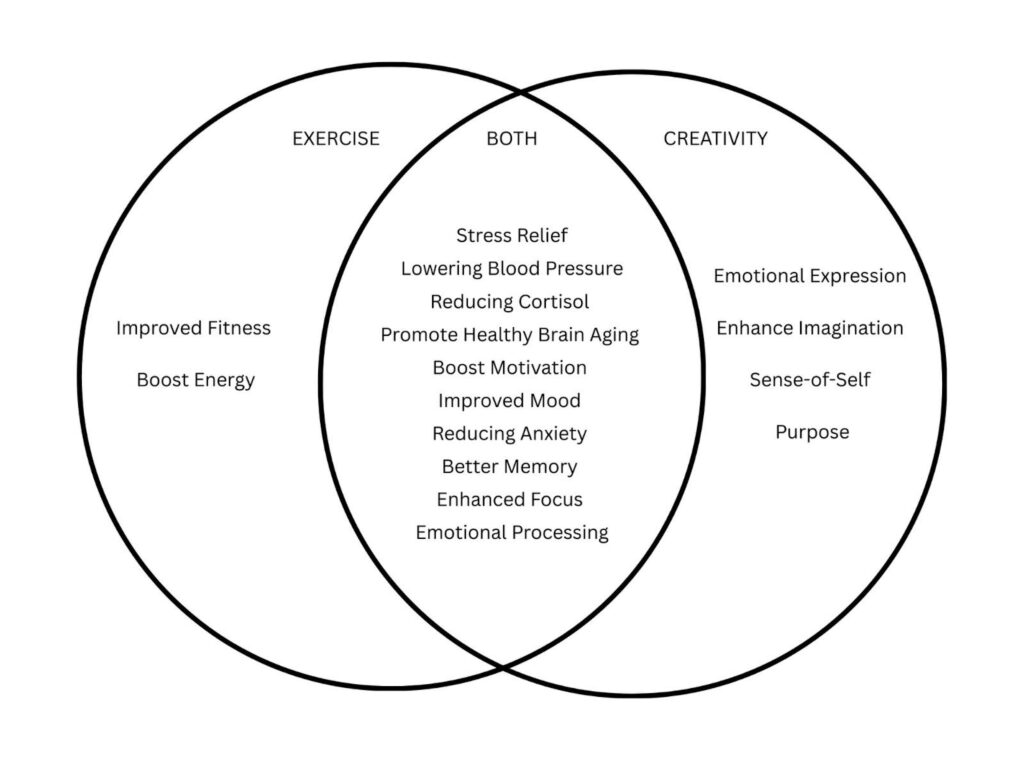
Both creativity and physical exercise overlap significantly with respect to wellbeing. In my view, creativity presents itself as an accessible, low strain self-care ritual in comparison to physical exercise. Additionally, the creative process targets your sense-of-self and purpose through expressing yourself through your imagination. This process can provide a deeper and richer experience with life.
Similar to exercise, creativity can enhance your focus during a work break, or serve as a way to let go of the day and transition to home life. These small acts of creativity are a way to restore energy and attention so that you can be more productive, or show up fresh at home. A wandering mind also allows you to reflect on problems you are facing, and come up with creative solutions.
Creativity is an activity sometimes referred to as active relaxation. These are activities that are not strenuous, but do require a level of engagement. In comparison, watching television or scrolling on social media might be called passive relaxation. Active relaxation allows your mind to address and interpret the experiences of the day, and any emotions you might be experiencing, whereas passive relaxation simply turns all that off. Active relaxation is a way to process what you are experiencing, connect to yourself, reflect on who you are and where you are going. Engaging in active relaxation boosts dopamine (the motivation chemical) and serotonin (the happiness chemical).
One of the blockers to engaging in the creative process I commonly hear about is related to mindset. But research shows that it doesn’t matter if you feel inspired or confident, showing up is enough to produce health benefits (Bolwerk et al., 2014). This mindset, or feeling that people are waiting for, is produced by the act of creativity itself, not something you wait for before starting. Engaging in creativity produces motivation (dopamine), and allows the mind to enter a state where it can play creatively.
I also hear people say, “I’m not creative”, “I can’t draw” (etc). Your brain does not mind if you are skilled at the activity or not, the benefits from engaging in the activity are all the same (Bolwerk et al., 2014). I think that this is encouraging, because we can drop any expectations to be good, and simply be in the moment. In a similar vein, a creative hobby can produce “beginner gains”. Beginner gains refer to the experience of going to the gym and immediately seeing an improvement in your body. Over time it becomes more difficult to see the improvements. Because a new creative act is a novel experience, the sense of joy and positivity you can feel will be more obvious at first.
The last thing I commonly hear people say is that they do not have the time. But as little as 10 minutes before bed is better than nothing. In fact, 10 minutes of creativity before bed is a wonderful use of time. I wonder whether, because many people work for the majority of the day, we have a misconstrued relationship with time and engagement. The average office worker is only able to be productive for 3 hours a day. The most prolific authors (e.g., Steven Pressfield, Steven King) state that they are only creative for about 2 hours a day. In that respect, 10 minutes is fantastic, and if you are engaging in 1 hour of creative practice a day, you are half way to the most successful and well respected artists.
I’d like to end by wrapping creativity up into something you can do throughout your entire day in service of not only the creative hobby you are looking forward to, but how you engage with the world. Creativity is a holistic exercise. It is not binary. It is not just about the time you spend actively engaging in it, it’s about how you approach your whole day. You can look forward to your creative hobby, you can think of what you can add to it on your commute, or on your lunch break. You can discuss creative blocks with your family. A creative hobby becomes a self-fullfiling source of joy and excitement that can carry through the course of your day.
Creativity can also be seen in other parts of your seemingly mundane day if you let it. How you cook dinner, the route you take to work, the wording of an email, the outfit you choose and the way you style your hair, the order and way you wash and stack the dishes, your skin-care routine, planning your week, hosting a dinner party. These activities can become an actively creative exercise, with intention.
Here are a few suggested creative activities for those who do not currently have one:
- Cross stitching
- Dot-to-dot drawing
- Journaling
- Adult colouring in book
- Tap drumming
- Humming & singing
- Puzzles
- Painting
- Oregami
- Photography
- Collage
- Cooking
- Vision boarding
- Rearranging furniture or a bookshelf
- Haiku poetry
- Gardening
- Lego
- Renaming everyday objects
- Writing jokes
- Creating metaphors
- Blending teas
If you enjoyed this article, you may enjoy my content over on youtube, instagram & substack. I also offer tools, resources, coaching and other services via my website. I share about common creative problems and how they can be addressed in coaching, what we can learn from particular artists or works of art, the psychology behind creativity, and more.
My name is Thomas Jacob Pearce and I am a Psychologist, Musician and Writer from Adelaide, Australia. Special thanks to Trisna for letting me write for you all.
LINKS:
https://pursuitofcreativity.co
https://substack.com/@pursuitofcreativity
https://www.instagram.com/pursuit.of.creativity
https://www.youtube.com/@TheCreativePsychologist/featured
Reference:
Bolwerk, A., Mack-Andrick, J., Lang, F. R., Dörfler, A., & Maihöfner, C. (2014). How art changes your brain: Differential effects of visual art production and cognitive art evaluation on functional brain connectivity. PloS one, 9(7), e101035.